
Picture this. It is 2015, and you are trying to find a good place to eat. You pull out your phone, open a browser, and awkwardly type “best pizza near me.” You sounded like a caveman talking to a robot. Now snap back to reality in 2026. You are driving your car, your hands are glued to the steering wheel, and you simply ask the empty air, “Hey, where can I get a really good slice of pepperoni pizza on my way home?”
Do you see the massive shift there? We stopped speaking to computers like they are machines. We finally started speaking to them like they are our friends sitting in the passenger seat.
This single behavioral change has completely shattered the traditional rulebook of digital marketing. If your website is still stuffed with awkward, robotic keyword phrases, you are essentially speaking a dead language. Today, voice search optimization vs traditional seo is the most critical battleground for your digital presence. Natural language has taken the throne, and the businesses that adapt are the ones scooping up all the traffic.
Let’s break down exactly how this happened, why your old strategy is failing, and how you can rebuild your website’s content to capture the massive wave of conversational searchers. Grab a cup of coffee, and let’s dive in.
The Death of the Robot Voice and the Rise of Human Conversation
For over a decade, we were trained by search engines to type in broken English. We believed that if we stripped away all the filler words—the “who,” “what,” “where,” “and,” “the”—Google would understand us better. We would search for “buy cheap shoes online” instead of “where can I buy some affordable shoes online right now?”
Marketers responded by building entire websites around these clunky, unnatural phrases. We would force “buy cheap shoes online” into our page titles, our headers, and our paragraphs. It made reading articles on the internet feel like reading a badly translated instruction manual.
But artificial intelligence evolved. Natural Language Processing (NLP) got insanely smart. Search engines realized that forcing humans to speak like robots was a terrible user experience. They updated their algorithms to understand context, intent, and the natural flow of human speech. Suddenly, the smart speakers in our living rooms and the virtual assistants in our phones could understand us perfectly when we spoke normally.
The result? The short, choppy keywords died. The long, conversational queries took over. If you want to survive in 2026, you have to write exactly how you speak.
Why Traditional SEO Is Losing Its Grip on Modern Searchers
Traditional SEO was a lot like playing a game of matching cards. If the user typed a word, and you had that exact word on your website, you won the click. It was a one-to-one relationship.
Voice search doesn’t play that game. When people speak, they don’t just use different words; they reveal their underlying intent. They ask questions. They demand immediate solutions.
Think about the sheer speed of voice. Most humans can type around 40 words per minute, but we can easily speak 150 words per minute. Because talking requires zero physical effort, our voice queries are significantly longer, incredibly detailed, and highly specific.
If someone types “web design agency,” they might just be looking for inspiration. But if they say, “what is the best web design agency to help me migrate from a template to a custom site,” they have their wallet out. They are ready to hire. If your content only targets the broad, traditional keywords, you are missing out on the hyper-qualified leads who are literally asking for your exact service out loud.
The Psychology Behind How We Speak Versus How We Type
To truly master voice search, you have to become a bit of a psychologist. You need to understand the human brain and the context in which people use voice commands.
Usually, people use voice search when their hands or eyes are occupied. They are driving, cooking, working out, or wrangling a toddler. Because they are multitasking, they lack patience. They do not want a list of ten blue links to read through. They want one single, definitive answer read back to them instantly.
This is the winner-takes-all reality of voice search. On a traditional search results page, ranking on page one in the fifth position still gets you some traffic. In voice search, if you aren’t the number one answer—the single snippet the device reads out loud—you literally do not exist.
This means your content cannot just be “good enough.” It must be the most accurate, concise, and helpful answer available on the internet. You have to anticipate the exact phrasing of the user’s anxiety or desire and address it directly.

How Voice Search Impacts Local SEO and Service Businesses
If you run a local service business, voice search is the most powerful tool in your entire marketing arsenal. The vast majority of voice searches have a massive local intent. People use their phones to find things they need right now, right where they are standing.
Let’s say you manage the marketing for a local landscaping company. Five years ago, your primary goal was to rank for “landscaping services.” Today, a homeowner is standing on their porch, looking at an overgrown lawn, holding a cup of coffee, and asking their smart watch, “Who can come cut my grass and redesign my patio this weekend?”
If your website just has a generic list of services, the virtual assistant will ignore you. Your website needs to explicitly state, “We offer weekend lawn care and patio redesign services right here in your neighborhood.”
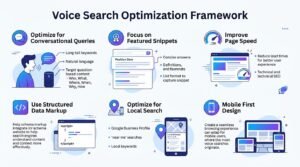
This is where finding the best digital marketing strategies for small business intersects heavily with voice optimization. Your Google Business Profile must be flawlessly updated. Your hours of operation, your exact location, and your customer reviews are the data points the AI uses to decide if you are the right answer for that spoken query. Local seo tips to rank on google maps now revolve entirely around establishing extreme local relevance so the AI trusts you enough to recommend you out loud.
Ecommerce and Voice The Invisible Shopping Cart
Voice search is revolutionizing the way we buy products. We are entering the era of the invisible shopping cart, where transactions happen entirely through dialogue without the user ever seeing a screen.
Imagine you are running a dropshipping operation targeting the UK market, or perhaps you manage a brand selling high-end boutique perfumes online. The buying journey has radically changed. When someone is getting ready for a special evening, they don’t sit down at a desktop to type “buy perfume.” They ask their device, “What is a really good, long-lasting fragrance for a winter date night?”
Your product pages can no longer just be a bulleted list of ingredients or dimensions. They need to tell a story. They need to include the exact conversational phrases your customers are using. You need to include sections on your product pages that answer questions like “How long does this fragrance last?” or “Is this product shipped locally from the UK?”
If your e-commerce platform isn’t structured to answer these spoken questions, you will lose the sale to a competitor who took the time to write human-centric product descriptions.
Restructuring Your Website Content for Natural Language
So, how do you actually fix your website? How do you transition from a clunky keyword factory into a smooth, conversational resource? You have to rethink your architecture from the ground up.
First, you need to fall in love with the FAQ page again. Frequently Asked Questions are the absolute best way to capture voice search traffic. But don’t just create one massive, messy page of random questions. Integrate specific, targeted FAQs at the bottom of every single service page or product page on your site.
Use long-tail question keywords as your headers. Instead of a header that says “Custom Development,” use an H2 that says “Why should you choose custom web development vs wordpress templates?”
Right below that header, immediately answer the question in two to three clear, concise sentences. This is the exact format that AI assistants look for when they are hunting for a snippet to read out loud. Give them the summary up front, and then use the rest of the paragraph to dive into the deeper, technical details for the humans who actually end up visiting the page.
The Technical Side of Voice Search Schema Markup and Site Speed
Content is king, but technology is the castle that protects the king. You can have the most beautiful, conversational content in the world, but if your website is a technical disaster, voice assistants will skip right over you.
Voice search is all about speed. When a user asks a question, the device needs to provide the answer in milliseconds. If your website takes four seconds to load a heavy image or a bloated theme, you are automatically disqualified. This is exactly why serious brands constantly seek out wordpress speed optimization service providers. You have to ensure your code is clean, your images are compressed, and your server response time is lightning fast.
Furthermore, you have to speak the secret language of search engine bots: Schema Markup. Schema is a type of microdata that you add to your website’s code. It doesn’t change how your website looks to humans, but it organizes your data beautifully for the bots.
If you publish a blog post, schema tells the search engine, “This is an article, the author is John, it was published on Tuesday, and it answers these five specific questions.” It removes all the guesswork. When an AI assistant needs a fast answer for a voice query, it will always pull from a website that has structured its data clearly over a website that forces the bot to guess.
Automating Your Voice Search Data Collection
Here is a major challenge with voice search: how do you know what questions people are asking? Traditional keyword research tools are great for typed queries, but they often miss the nuanced, conversational questions people ask their smart speakers.
This is where you need to get clever with automation. You cannot manage a modern digital strategy manually. You need to automate the gathering of customer intent.
Imagine setting up advanced automation workflows using powerful visual tools like n8n. You can automatically pull every single question a customer asks your support team via email, strip the data, and drop it into a spreadsheet. You can automate the extraction of questions people leave in your YouTube comments or on your competitor’s social media pages.
By automating your business workflows, you create a living, breathing database of the exact natural language phrases your target audience uses every single day. Once you have that data, you hand it to your content team and say, “Write articles that answer these exact questions.” It takes the guesswork out of content creation. You aren’t guessing what they might search for; you are answering what they are already asking.
How to Choose the Right SEO Agency for Voice Optimization
If you are reading this and feeling slightly overwhelmed, take a deep breath. You don’t have to rebuild your entire digital presence alone. However, if you decide to bring in outside help, you must be incredibly careful.
The digital landscape is flooded with outdated agencies still selling link-building packages from 2018. When figuring out how to choose the right seo agency in 2026, you need to ask them some tough questions.
Ask them how they track voice search metrics. Ask them about their approach to generative AI and natural language processing. If their entire proposal is just a list of short-tail keywords and a promise to “get you to page one,” run the other way. You need a partner who understands user psychology, technical architecture, and content strategy. You need an agency that builds digital experiences, not just landing pages. Look for a team that is transparent, data-driven, and focused on your actual revenue, not just vanity metrics.

Final Words
The transition from typed keywords to natural language voice search isn’t a future prediction; it is our current reality. The internet has evolved from a silent, text-based library into a noisy, interactive conversation.
The businesses that refuse to adapt—the ones that keep stuffing awkward phrases into their blog posts and ignoring the technical speed of their websites—will slowly become invisible. But the businesses that embrace this change have an incredible opportunity.
By writing exactly how your customers speak, anticipating their most pressing questions, and answering them with clarity and speed, you position your brand as the ultimate authority in your space. You aren’t just ranking on a page anymore; you are becoming the trusted voice in your customer’s ear.
So, take a hard look at your website today. Read your homepage out loud. Does it sound like a helpful human, or does it sound like a desperate robot trying to game an algorithm? Make the change. Start the conversation. The digital world is listening.