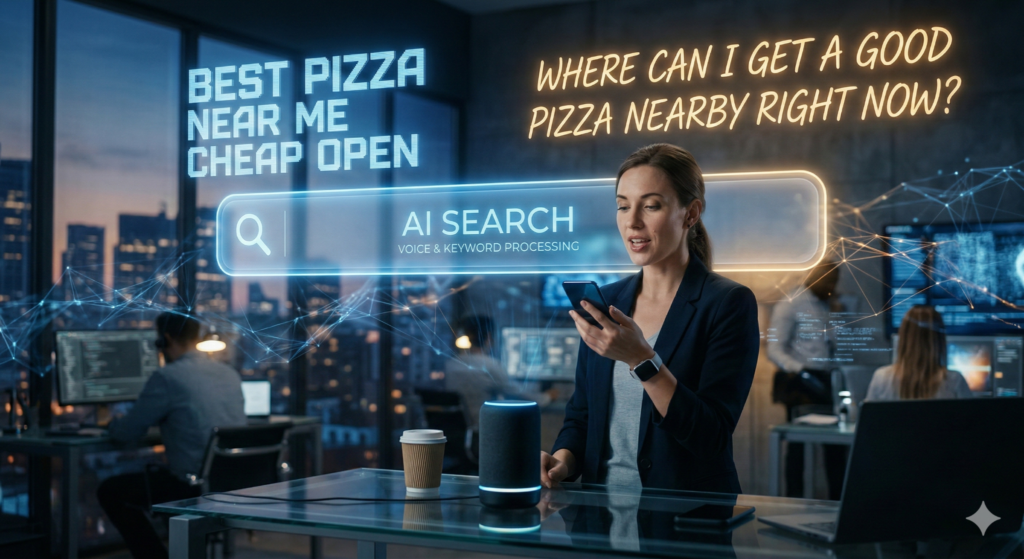
Today, Google doesn’t want to introduce the user to you; it wants to answer the question itself so the user never has to leave the search engine. Welcome to the era of the zero-click search. If you’re still measuring your marketing Return on Investment (ROI) entirely by website clicks, you are measuring a ghost town.
Let’s talk about how the landscape has shifted and, more importantly, how you can actually track your marketing success when nobody is clicking on your links.
The Ghost Town of Search Engine Results Pages
Let’s look at the cold, hard numbers. According to recent 2025 and 2026 data from SparkToro and Similarweb, roughly 60% of all Google searches now end without a single click to an external website. On mobile devices? That number skyrockets to a staggering 77%.
Think about that for a second. For every 1,000 people who search for a problem your business solves, over 600 of them get their answer directly on the Search Engine Results Page (SERP) and immediately close their browser.
Google is no longer just a transit system; it is the final destination.
What Exactly Is a Zero Click Search
A zero-click search happens when a user types a query into a search engine and gets their answer directly on the results page. They don’t need to click a blue link. Their itch has been scratched.
What causes this? A whole army of SERP features:
- AI Overviews (AIO): Google’s generative AI that synthesizes answers from multiple websites into one neat paragraph at the very top of the page.
- Featured Snippets: Those little boxes that pull a direct quote, list, or table from your website.
- Knowledge Panels: The sidebars filled with fast facts, usually pulled from Wikipedia or Google Business Profiles.
- Local Packs: The map results showing phone numbers, reviews, and hours of operation.
If someone searches “What is a zero-click search,” Google’s AI just tells them. Boom. Transaction over. No clicks for you.
Why You Need to Stop Panicking Over Dropping Traffic
Over the last five plus years of my career, I’ve had the privilege of optimizing more than 300 websites for businesses large and small. Right now, almost all of those business owners are calling me in a panic.
“Our traffic is down 30% year-over-year! The sky is falling! Turn off the SEO budget!”
I have to talk them off the ledge. I tell them to look closer at their analytics. Yes, top-of-funnel blog traffic is down. But are sales down? Are qualified leads dropping? Usually, the answer is no.
Traffic is a vanity metric. If a user was only coming to your site to find a quick definition and bounce three seconds later, that click was financially worthless anyway. We have to stop mourning the loss of cheap clicks and start celebrating the evolution of high-intent visibility.
The Death of the Traditional Click Through Rate
For a decade, Click-Through Rate (CTR) was our holy grail. If your CTR was dropping, your SEO was failing. But how do you calculate the CTR of a user who read your brand’s insight inside an AI Overview, nodded their head, and walked away impressed without clicking?
You can’t.
Studies show that when an AI Overview is present on a search page, organic CTR drops by nearly 40%. The old metric is broken. If you present a CTR report to your boss or your client today to prove your marketing ROI, you are using a tape measure to weigh a bowling ball. It’s the wrong tool for the job.
How Search Generative Experience Flipped the Funnel
Search Generative Experience (SGE) and AI tools like ChatGPT and Perplexity have fundamentally changed user behavior. Users are no longer explorers hunting through ten blue links. They are passive consumers having a conversation with an omniscient robot.
This collapses the “research” phase of the buyer journey. Instead of visiting five different blogs to compare software, the user asks AI to do the comparison for them.
But here is the silver lining: The AI still needs sources. When Google’s AI Overview tells a user how to solve a problem, it cites the websites it pulled the data from. If your brand is the one being cited, you are borrowing Google’s ultimate authority.
Brand Impressions Are the New Currency
If we can’t track clicks, what do we track? We track influence. We track real estate.
Owning the “Position Zero” spot, whether it’s an AI citation or a Featured Snippet, is a massive trust signal. It’s the digital equivalent of a highway billboard. You don’t expect someone driving 70 miles per hour to click on a billboard, right? But when they pull into the next town and need a burger, they remember the sign.
The impact of zero-click searches on marketing ROI means we must value Brand Impressions. Being seen as the authoritative source by an AI engine builds immense brand equity. The user might not click today, but when they are finally ready to buy, whose name is lingering in the back of their mind? Yours.
New Metrics for a New Era of SEO
So, how do we put numbers on a spreadsheet to prove this is working? You need to shift your focus to a metric called Share of Search.
Share of Search is the volume of search queries for your specific brand name compared to your competitors. If your informational content is getting scraped and cited by AI Overviews (resulting in zero clicks), you should eventually see a corresponding lift in people specifically Googling your brand name later down the line.
You measure the ROI of zero-click searches by looking for correlation, not direct attribution. If your “un-clicked” visibility goes up in March, and your direct traffic and branded searches go up in April, that is your ROI.
Tracking Dark Social and Untraceable Word of Mouth
We also have to acknowledge “Dark Social.” This is the sharing of your content in places analytics can’t track: Slack channels, Discord servers, WhatsApp group chats, and unlinked mentions.
When your content is featured in a zero-click result, people take screenshots. They copy and paste the text to their colleagues. “Hey, look at this cool framework Creaeza put together.”
To track this, you need to implement qualitative data. Put a simple drop-down menu on your intake forms: “How did you hear about us?” You’ll be shocked at how many people type “Saw your answer on Google” or “Someone mentioned you in a forum,” even though your Google Analytics says they came from “Direct Traffic.”
Automating Your Data With Smart Tools
Because the customer journey is now fractured and invisible, manual tracking is impossible. You need intelligent systems to stitch the narrative together.
This is where backend automation becomes your best friend. Instead of relying purely on Google Analytics, smart marketers are building custom tracking pipelines. For instance, developing an expertise in n8n automation allows you to connect your CRM, your website forms, your ad platforms, and your social listening tools into one cohesive brain.
When a lead finally converts, your automated workflow can look back across all platforms to see if that user interacted with an untracked video, a LinkedIn post, or a branded search weeks earlier. By automating data aggregation, you stop guessing and start seeing the hidden ROI.
Optimizing for the Snippet Instead of the Click
If the goal is to be the source material for the AI, how do you write for it? You transition from Search Engine Optimization (SEO) to Generative Engine Optimization (GEO).
AI engines are essentially highly advanced summary machines. They hate fluff. If you write a 500-word introduction about the history of coffee before answering “how much caffeine is in a dark roast,” the AI will ignore you.
You must structure your content for extraction:
- Use clear, question-based H2 and H3 headings.
- Answer the question immediately beneath the heading in 2-3 concise sentences.
- Use bulleted lists and tables for data.
- Implement robust Schema Markup so the bots understand exactly what your page is about without having to guess.
Provide the “What” for the AI to scrape, and save the “How-To” or the proprietary tool for the human to click on.
Real World Examples Dropshipping and Local Services
Let’s put this into a real-world perspective. Say you are managing a dropshipping business in the UK.
A user searches “average shipping times from China to UK 2026.” Google’s AI Overview pops up and says “7 to 12 days,” citing your dropshipping blog. The user doesn’t click. They got their answer. Zero-click search.
Did you lose? No. Because right next to that answer is your brand logo. You just positioned your store as the authority on UK logistics. Three days later, when that same user is ready to order a product, they skip the generic search and type your brand name directly into the search bar because they remember you.
The same applies to local services. If someone searches for an emergency plumber, they aren’t going to browse your “About Us” page. They look at the Google Local Pack, see your 5-star rating, and tap the “Call” button directly from the search results. Zero clicks to your website. But it resulted in a $500 job. If you were only tracking website traffic, you’d think your SEO was failing.
Why Human Content Still Wins in a Zero Click World
Here is the irony of the AI revolution: The more AI-generated summaries take over the search results, the more valuable human, experience-driven content becomes.
AI can synthesize facts, but it cannot synthesize experience. It has never built a mobile app. It has never lost money investing in the Pakistan Stock Exchange. It has never stayed up until 3 AM debugging a WordPress site.
If your content is just a regurgitation of facts, you will be eaten alive by zero-click AI summaries. But if your content is filled with first-hand experience, unique data, strong opinions, and real-world case studies, the AI will use you as the primary source. Furthermore, when users click through because they want the deep dive, your human voice is what will ultimately convert them into a paying client.
How We Adapt Our Digital Marketing Strategy Moving Forward
So, how do we survive and thrive as marketers in 2026? We stop treating Google like a traffic dispenser and start treating it like an awareness platform.
- Embrace the Billboard Effect: Optimize your informational content to be featured in snippets and AI overviews. Accept the zero-click reality and bank the brand awareness.
- Gate Your Best Value: Give away the “What” and the “Why” for free to satisfy the AI, but keep the “How” inside interactive tools, templates, or email newsletters that require a deeper commitment.
- Diversify Your Traffic: Stop relying solely on organic search. Build your email list, invest in community building, and leverage video platforms like YouTube where engagement is still deep and measurable.
- Change Your Reporting: Educate your stakeholders. Replace CTR and Top-of-Funnel Traffic with Share of Search, Brand Mentions, and overall pipeline revenue.
Final Words
The sky isn’t falling; it’s just changing colors. Zero-click searches haven’t killed SEO; they have simply matured it. We are no longer chasing cheap clicks from bored scrollers. We are building digital authority. By understanding that visibility without a click is still highly valuable, and by updating the way we track our data, we can prove the true ROI of our marketing efforts. Stop chasing the click, and start chasing the influence. The clicks that matter will follow.